A South Carolina Official Wood Infestation Report, universally referred to as a CL-100 report, is governed by the South Carolina Structural Pest Control Act through Clemson University Regulatory Services. In Charleston…
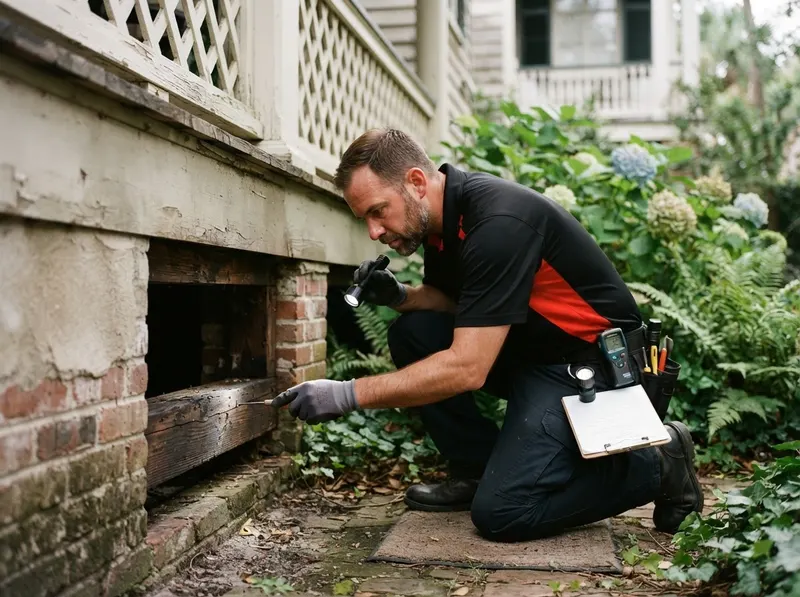
A South Carolina Official Wood Infestation Report, universally referred to as a CL-100 report, is governed by the South Carolina Structural Pest Control Act through Clemson University Regulatory Services. In Charleston County real estate transactions, mortgage lenders require this clearance document within 30 to 45 days of loan closing. The document reports two separate conditions: structural infestation by wood-destroying insects such as subterranean termites or wood-boring beetles, and structural wood-decay fungi supported by excessive moisture. A CL-100 differs fundamentally from a routine annual termite warranty check because it documents past damage, current structural risks, and ambient moisture metrics rather than simply verifying that chemical barrier treatments remain active.
Older coastal residential architecture demands rigorous evaluation of raised foundations. Historic homes across South of Broad, Radcliffeborough, and Harleston Village rely on heart-pine framing resting on masonry brick piers or mortared stone footings. In these structures, ambient humidity moving upward through unlined subfloors frequently elevates joist moisture content past the critical 20% decay threshold. During an official inspection, a calibrated pin-style moisture meter measures structural subflooring at multiple locations, while wood sills and band joists near ground level are hand-probed for subterranean termite galleries. In post-war neighborhoods such as Wagener Terrace and Hampton Park Terrace, crawlspaces framed closer to grade often exhibit fungal rot alongside old termite tunneling in rim joists beneath kitchens and bathrooms.
Modern crawlspace designs and slab constructions present distinct inspection profiles. Elevated crawlspaces in West Ashley, James Island, and Daniel Island often experience standing water or elevated humidity during severe tidal cycles, river storm surges, or high summer humidity surges. An Official Wood Infestation Report documents whether ground-cover vapor barriers cover at least 80% of exposed soil, whether foundation wall crawlspace vents are operable, and whether structural wood moisture levels reach or exceed 28%, which triggers active fungal breakdown. The inspector examines wood-to-ground contacts, such as exterior wood steps or porch framing touching damp coastal dirt, because direct contact voids standard real estate clearances.
The process follows four sequential steps: 1. The exterior perimeter foundation, masonry weep holes, and exterior water fixtures are surveyed for termite shelter tubes. 2. Crawlspaces are entered to probe foundational wood sills, cross-joists, subflooring, and pier caps. 3. Wood moisture readings are recorded across foundation quadrants using a calibrated resistance meter. 4. The multi-page official CL-100 state document is generated, detailing clearance status or documenting the specific location, insect species, fungal presence, or repairs required before closing.
Every job gets a firm, written price after a free on-site visit.
Tell us about your official wood infestation report inspections job in Charleston and we'll send a clear, written quote, usually the same day.
 Coastal Wren Pest Control