Coastal Wren Pest ControlCoastal Wren Pest Control

Subterranean Termite Treatment and Prevention Charleston

Subterranean termite defense in the South Carolina Lowcountry requires continuous barriers rather than simple surface applications. Native Eastern subterranean termites and aggressive Formosan subterranean colonies…
Get My Free Estimate →(854) 260-5729
Subterranean Termite Treatment and Prevention in Charleston, SC
Quick answer
  • What is included: Comprehensive crawlspace inspection, foundation trenching, liquid termiticide application, and tamper-resistant bait station placement.
  • Arrival and response: Standard visual evaluations occur within 24 to 48 hours across Charleston County.
  • Ballpark investment: Targeted initial spot applications begin at the $250 minimum, while complete residential perimeter systems average $850 to $2,400.
  • Targeted wood-destroying pests: Eastern subterranean termites (Reticulitermes flavipes) and Formosan subterranean termites (Coptotermes formosanus).
  • Scheduling process: Confirmed dates follow a baseline on-site inspection, reachable directly at (854) 260-5729.

Subterranean termite defense in the South Carolina Lowcountry requires continuous barriers rather than simple surface applications. Native Eastern subterranean termites and aggressive Formosan subterranean colonies live beneath the soil line, tracking moisture into floor joists, sill plates, and subflooring. In historic districts like South of Broad, Harleston Village, and Radcliffeborough, structures rest on soft brick piers with lime mortar, allowing worker termites to construct sheltered mud tubes unseen behind foundation latticework. Ground-level homes on concrete slabs across West Ashley and James Island present different entry points, where plumbing penetrations through the slab expand slightly during humid summers, giving workers direct access into stud walls.

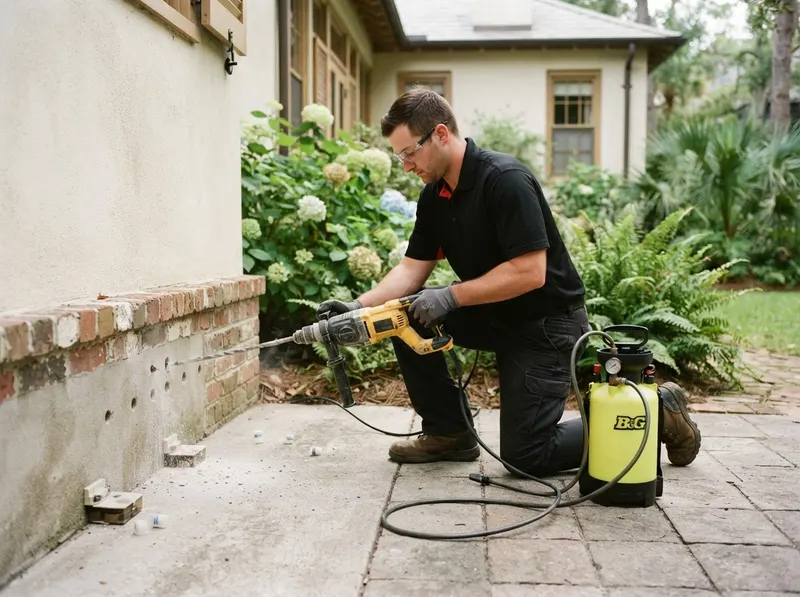
A complete prevention program pairs liquid termiticide barriers with baiting arrays. Liquid applications require excavating a continuous 6-inch trench into the soil along foundation stems and interior pier lines, saturating backfilled dirt at 4 gallons per 10 linear feet. In neighborhoods with high water tables such as Wagener Terrace and Hampton Park Terrace, non-repellent fipronil formulations bind tightly to organic coastal soil without washing out during routine king-tide street flooding. Bait stations spaced every 10 to 15 feet around building perimeters intercept subterranean foraging parties before workers contact structural framing. If structural timbers show existing infestation, localized non-repellent applications stop active feeding within 60 to 90 days.

Moisture control remains the vital non-chemical step for long-term termite suppression. Crawlspace relative humidity exceeding 70 percent along Daniel Island marshes softens heart-pine sills and yellow pine subflooring, speeding wood decay and inviting secondary termite nesting. Replacing torn 6-mil poly ground covers, clearing earth-to-wood soil contacts around deck posts, and inspecting crawlspace masonry ensure the chemical treatments maintain their full 5-to-10-year protective integrity. While hardware store aerosol sprays kill visible swarming termites, they trigger colony budding; true elimination depends on slow-acting chemistry that worker termites carry back to eliminate subterranean queens.

Subterranean Termite Treatment and Prevention cost in Charleston

Targeted Crawlspace Pier Spot Treatment$250 - $450
Standard Perimeter Liquid Trench Treatment (Up to 1,800 sq ft)$850 - $1,600
Large Home Perimeter Trench & Bait System (1,800 - 3,500 sq ft)$1,400 - $2,600
Annual Lowcountry Termite Monitoring & Inspection$250 - $375

Every job gets a firm, written price after a free on-site visit.

Common questions

What is the baseline cost for subterranean termite treatment in Charleston?
Base treatments in Charleston start at a $250 minimum charge for focused structural spot work, with comprehensive whole-house liquid barriers and bait systems scaling from $850 to $2,600 based on linear foundation footage and crawlspace clearance.
When do subterranean termites swarm across Charleston neighborhoods?
Eastern subterranean termites swarm during warm, sunny spring mornings between March and May, whereas Formosan subterranean termites stage flights on warm, humid evenings between late May and July, especially near marshland areas like James Island and West Ashley.
How does floodwater impact termite soil barriers in Charleston?
Modern non-repellent liquid termiticides adhere molecularly to Lowcountry clay and sandy loam soil particles, resisting wash-off from typical rain runoff, though severe tidal inundation in South of Broad warrants visual re-inspections.
Why are bait stations necessary alongside liquid treatments in Charleston?
Perimeter bait stations intercept aggressive Formosan subterranean colonies foraging in landscaped yards and tree roots before workers can locate the small foundation fissures common in historic Harleston Village masonry.
How do historic Charleston crawlspaces influence termite vulnerability?
Raised pier foundations and damp ground under historic homes create high-humidity environments that accelerate wood decay, giving subterranean termites direct access to structural sills through interior foundation voids.

Get started today

Tell us about your subterranean termite treatment and prevention job in Charleston and we'll send a clear, written quote, usually the same day.
Get your free Pest Control Service quote, Charleston

We only use your ZIP to check availability, no spam.