Coastal Wren Pest ControlCoastal Wren Pest Control

Rodent Trapping and Structural Exclusion Charleston

Historic architecture and coastal humidity make Lowcountry dwellings uniquely vulnerable to rodent infiltration. Roof rats native to maritime tree canopies readily traverse overhanging live oaks to breach louvered…
Get My Free Estimate →(854) 260-5729
Rodent Trapping and Structural Exclusion in Charleston, SC
Quick answer
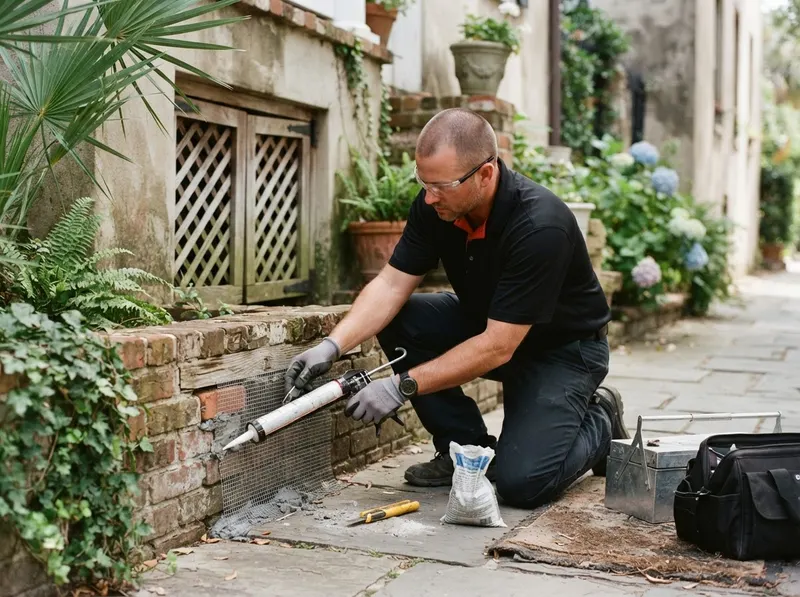
  • What is included: A comprehensive interior and exterior inspection, placement of mechanical snap traps, installation of 1/4-inch galvanized steel hardware cloth over entry points, sealing of mortar voids, and follow-up trap resets.
  • Project duration: Initial mechanical sealing takes 3 to 6 hours, followed by multi-week monitoring visits spaced 3 to 5 days apart until zero activity is recorded.
  • Service cost: Project minimum is $250 for isolated entries and basic snap-trapping lines, ranging up to $1,800 or more for comprehensive crawlspace perimeter and roofline exclusion on multi-story historic structures.
  • Pests removed: Roof rats (Rattus rattus), Norway rats (Rattus norvegicus), and standard house mice (Mus musculus).
  • Scheduling: Inspections and exclusion work are booked by phone at (854) 260-5729, with technicians dispatched across Charleston County.

Historic architecture and coastal humidity make Lowcountry dwellings uniquely vulnerable to rodent infiltration. Roof rats native to maritime tree canopies readily traverse overhanging live oaks to breach louvered attic vents, soffit corners, and roof junctions. In neighborhoods such as South of Broad, Harleston Village, and Radcliffeborough, aging mortar between historic Charleston brickwork frequently erodes, leaving entry gaps larger than 1/4 inch. Rodent exclusion resolves this root problem mechanically rather than relying on exterior rodenticide bait stations, which pose secondary poisoning hazards to local marsh raptors and leave deceased pests inside inaccessible wall cavities.

Structural exclusion focuses directly on physical vulnerabilities common to coastal foundations. Ground-level raised pier foundations in Hampton Park Terrace, Wagener Terrace, and West Ashley expose subflooring plumbing penetrations and crawlspace access doors. Unsealed crawlspace vents, HVAC chases, and gaps beneath historic wood siding allow rodents direct runways into floor joists. Technicians measure and cap every access point using heavy-gauge metal flashing, non-corroding copper mesh, and concrete-anchored 1/4-inch hardware cloth that chewing incisors cannot penetrate.

Selecting structural exclusion over recurring chemical baiting represents an upfront mechanical trade-off. Poison stations offer a lower initial dispatch expense but require indefinite quarterly contract fees without preventing outdoor rodents from continuing to enter living quarters. Comprehensive structural exclusion demands a larger single investment starting at the $250 minimum, yet it creates a permanent physical barrier. For raised cottages on James Island or newer construction along tidal waterways on Daniel Island, coupling complete perimeter sealing with dedicated indoor trapping delivers long-term population reduction without introducing persistent poisons into damp coastal air.

Rodent Trapping and Structural Exclusion cost in Charleston

Baseline Inspection & Targeted Trap Setup$250, $350
Standard Crawlspace Vent & Ground-Tier Exclusion (Single Family)$450, $850
High-Pitch Roofline & Soffit Sealing (Historic Two-Story)$750, $1,400
Whole-Structure Multi-Vulnerability Exclusion & Trapping Sequence$1,200, $1,800+

Every job gets a firm, written price after a free on-site visit.

Common questions

Why are roof rats uniquely persistent in Charleston homes?
Charleston possesses dense maritime tree canopies, Spanish moss, and abundant outdoor water sources near the Ashley and Cooper rivers, providing roof rats with continuous arboreal pathways directly onto residential rooflines.
What materials are used to seal historic brick and wood foundations in Charleston?
Technicians utilize rust-resistant copper mesh, concrete repair mortars, and 1/4-inch galvanized hardware cloth to close weep holes, foundation vents, and timber gaps without causing structural moisture retention in humid climates.
How does raised pier crawlspace exclusion work for historic Charleston properties?
Exclusion teams install custom-fitted hardware cloth barriers around crawlspace floor piers, secure perimeter access doors, and seal utility penetrations using metal flashing to prevent rodents from climbing foundation supports.
How many follow-up visits are required during a rodent trapping program in Charleston?
A typical trapping protocol includes 2 to 4 follow-up inspections spaced roughly 72 to 120 hours apart to clear traps, verify catch counts, and confirm that zero new entry points have opened.
Can structural exclusion be completed on Daniel Island and James Island newer builds?
Yes, modern slab-on-grade and stilted construction commonly contain rodent pathways around AC condensate lines, garage door corner seals, and vinyl soffit returns, all of which are sealed using rigid metal exclusion components.

Get started today

Tell us about your rodent trapping and structural exclusion job in Charleston and we'll send a clear, written quote, usually the same day.

Get your free Pest Control Service quote, Charleston

We only use your ZIP to check availability, no spam.