Coastal Wren Pest ControlCoastal Wren Pest Control

Powderpost Beetle Structural Treatment Charleston

Powderpost beetles (primarily Lyctinae and Anobiidae families) threaten Charleston structures when ambient relative humidity pushes interior wood moisture content past 12 percent. In historic neighborhoods like South…
Get My Free Estimate →(854) 260-5729
Powderpost Beetle Structural Treatment in Charleston, SC
Quick answer
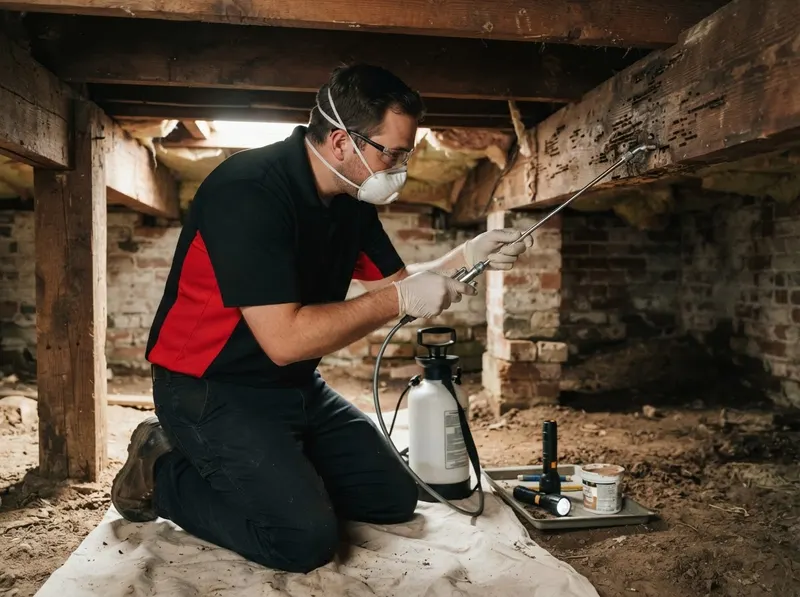
  • What is included: Moisture meter testing, vacuum frass clearing, and pressurized topical application of disodium octaborate tetrahydrate (DOT) to bare structural framing.
  • Turnaround time: On-site inspection takes 60 to 90 minutes; structural borate treatments cure within 24 to 48 hours depending on humidity.
  • Cost range: Ballpark estimates range from $500 to $2,800 depending on crawlspace square footage, with a strict $250 minimum charge.
  • Targeted materials: Unsealed subfloors, heart-pine floorboards, joists, sills, and exposed structural wood in pier-and-beam foundations.
  • Scheduling: Inspections are booked directly by phone at (854) 260-5729 or confirmed via clear photos of frass and exit holes.

Powderpost beetles (primarily Lyctinae and Anobiidae families) threaten Charleston structures when ambient relative humidity pushes interior wood moisture content past 12 percent. In historic neighborhoods like South of Broad, Harleston Village, and Radcliffeborough, antique heart pine, ash, and oak joists absorb tidewater humidity, creating ideal feeding grounds for larvae. The beetle larvae tunnel through the sapwood for 1 to 5 years, converting dense framing into fine, flour-like wood powder before emerging through 1/32-inch to 1/8-inch pinholes. Topical hardware store insecticide sprays fail because they remain on the surface, leaving tunneling larvae completely unharmed deep inside load-bearing timbers.

Treatment selection depends on wood finish and moisture levels. Penetrating borate salt solutions (disodium octaborate tetrahydrate) serve as the primary structural remedy for accessible, unfinished framing in crawlspaces across Hampton Park Terrace, Wagener Terrace, and West Ashley. Borate diffuses through the cellular structure of damp wood, permanently poisoning the cellulose against feeding larvae. However, borates cannot penetrate sealed, painted, or polyurethane-coated historic flooring. When beetle emergence holes appear on finished hardwood floors in Daniel Island or James Island homes, remediation requires localized micro-injection, targeted floorboard replacement, or whole-structure enclosure fumigation if structural framing is inaccessible.

Crawlspace conditions dictate remediation longevity. In Charleston County, raised pier foundations without adequate vapor barriers continually wick ground dampness into subfloor timbers. Powderpost beetle activity naturally ceases once wood moisture drops permanently below 10 to 12 percent. Consequently, applying chemical borates without pairing the work with crawlspace ground covers, automated dehumidification, or vent management leaves the underlying moisture vulnerability open. Addressing moisture content in conjunction with borate salt applications preserves the timber without unnecessary long-term chemical reliance.

Powderpost Beetle Structural Treatment cost in Charleston

Localized Joist Spot Treatment (under 250 sq ft)$250 - $450
Standard Crawlspace Borate Application (1,000 - 1,500 sq ft)$850 - $1,600
Large or Historic Crawlspace Treatment (2,000+ sq ft)$1,800 - $2,800
Detailed Wood-Destroying Organism (WDO) Inspection$250

Every job gets a firm, written price after a free on-site visit.

Common questions

How can homeowners tell if powderpost beetle damage is active in Charleston?
Active powderpost beetle infestations produce fresh, cream-colored wood powder (frass) that falls from exit holes onto horizontal surfaces beneath Charleston crawlspace joists. If frass is swept away and reappears after several weeks, or if wood moisture measures above 12 percent on a calibrated pin meter, larvae are actively tunneling.
What is the difference between subterranean termites and powderpost beetles in Charleston homes?
Subterranean termites construct exterior mud tubes to travel from soil to framing and consume wood along the grain, whereas powderpost beetle adults lay eggs in wood pores, producing pinhead-sized exit holes and powdery frass rather than mud tubes.
Does borate structural treatment damage historic Charleston heart pine?
Borate structural treatment does not stain, weaken, or warp historic longleaf heart pine timbers found in Charleston properties. Disodium octaborate tetrahydrate dries clear and leaves natural wood grain intact while remaining embedded in the wood fibers indefinitely as long as the framing stays sheltered from direct rainwater runoff.
Can powderpost beetles spread from a Charleston crawlspace into modern furniture?
Powderpost beetles rarely spread from damp crawlspaces into air-conditioned living spaces because indoor furniture typically maintains a wood moisture content below 8 to 10 percent, which is too dry for anobiid larvae to survive. True powderpost beetles (lyctids) prefer unsealed hardwoods with large pores and starch content, which are absent in most sealed, modern indoor furnishings.
What preparation is required before a crawlspace powderpost beetle treatment in Charleston?
Preparation requires removing stored personal items, clearing standing water, and securing unsealed crawlspace ductwork beneath the Charleston home. Bare subflooring and framing must be dry enough to absorb the aqueous borate solution, meaning standing puddles and severe foundation leaks must be resolved prior to application.

Get started today

Tell us about your powderpost beetle structural treatment job in Charleston and we'll send a clear, written quote, usually the same day.

Get your free Pest Control Service quote, Charleston

We only use your ZIP to check availability, no spam.