Coastal South Carolina conditions create constant roach pressure along tidal corridors and marsh borders. The American cockroach, locally termed the palmetto bug, reaches mature lengths of 1.5 to 2.1 inches and thrives…
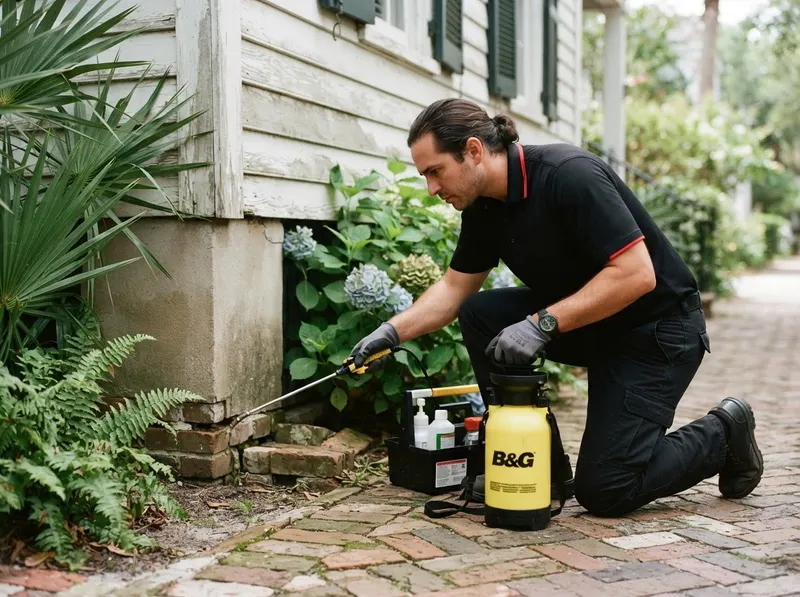
Coastal South Carolina conditions create constant roach pressure along tidal corridors and marsh borders. The American cockroach, locally termed the palmetto bug, reaches mature lengths of 1.5 to 2.1 inches and thrives within relative humidity levels exceeding 70%. In historic neighborhoods like South of Broad, Harleston Village, and Radcliffeborough, raised brick-pier foundations, heart-pine floor gaps, and unsealed masonry weep holes provide direct pathways from damp soil into climate-controlled interiors. Similarly, crawlspace subfloors in Wagener Terrace and Hampton Park Terrace frequently absorb subterranean ground moisture, generating fungal microclimates that shelter overwintering nymphs. Palmetto bug and cockroach management targets these entry points directly rather than relying on superficial baseboard aerosols that fail to disrupt the nesting perimeter.
Management protocols differ substantially between peridomestic species and indoor-breeding infestations. Outdoor roaches, specifically American and smokybrown varieties, reside primarily in oak canopies, pine mulch beds, and crawlspaces, entering structures opportunistically during dry heat spells or heavy pluvial rains. For these invaders, applying microencapsulated non-repellent liquid barriers along exterior foundations paired with moisture-resistant granular baits in perimeter landscaping arrests movement into the home. Conversely, German cockroaches measure between 0.5 and 0.6 inches, reproduce entirely indoors within galley kitchens or wall voids, and require precise gel baiting using insect growth regulators (IGRs) that stop chitin formation without repelling the population into adjacent rooms. The trade-off between exterior liquid barrier applications and interior void baiting is localized impact versus broader habitat reduction: external barriers stop continuous woodland migrations, while internal IGR placements eliminate persistent breeding clusters inside cabinetry.
Slab foundations common across newer constructions in West Ashley, James Island, and Daniel Island experience different ingress patterns. Expansion joints, plumbing penetrations through the concrete floor, and soffit vents under roof overhangs serve as the primary entry vectors. Service workflows follow a structured sequence: 1. Moisture meter and visual mapping of ground-level voids, historic crawlspaces, and pipe chases. 2. Application of boric or silica dust within dry wall voids and electrical plumbing penetrations where roaches travel. 3. Placement of non-staining microencapsulated pyrethroid or neonicotinoid compounds across exterior stone footings, foundation piers, and access doors. 4. Strategic distribution of weather-rated bait stations along shaded mulch beds, HVAC condensation drain lines, and live oak canopies within 15 feet of structural perimeters. Physical barriers and crawlspace relative humidity stabilization below 60% substantially reduce long-term pest reproduction without unnecessary recurring indoor applications.
Every job gets a firm, written price after a free on-site visit.
Tell us about your palmetto bug and cockroach management job in Charleston and we'll send a clear, written quote, usually the same day.
 Coastal Wren Pest Control